
DJI Zenmuse H30T
.png)
.png)
.png)
.png)
.png)
.png)
DJI Zenmuse H30T
1 Year
Warranty
7 Days
Replacement
In House
Repairs
Sealed
Packed

1280×1024 thermal.
Twice what H20T delivered.
The H30T's thermal module captures 1280×1024 radiometric imagery at 30Hz — exactly double the H20T's 640×512 resolution. At 12μm pixel pitch with NETD ≤50mK at f/1.0, you resolve thermal anomalies the previous generation couldn't see. Temperature measurement range -20° to 1600° C (with the optional Infrared Density Filter for the high end). Power line corona discharge, substation hotspots, building envelope leaks — visible at standoff distances that previously needed flying lower.
VOx microbolometer.
52mm lens, f/0.95.
Uncooled VOx microbolometer with 24mm actual focal length (52mm equivalent), aperture f/0.95 — extraordinarily fast for an enterprise thermal lens. Spectral band 8-14μm covers the long-wave infrared range used for thermal radiometry. 32× digital zoom. R-JPEG output format embeds per-pixel temperature data for post-flight analysis in DJI Thermal Analysis Tool 3. Sun-burn protection prevents pixel damage when the lens points toward the sun.
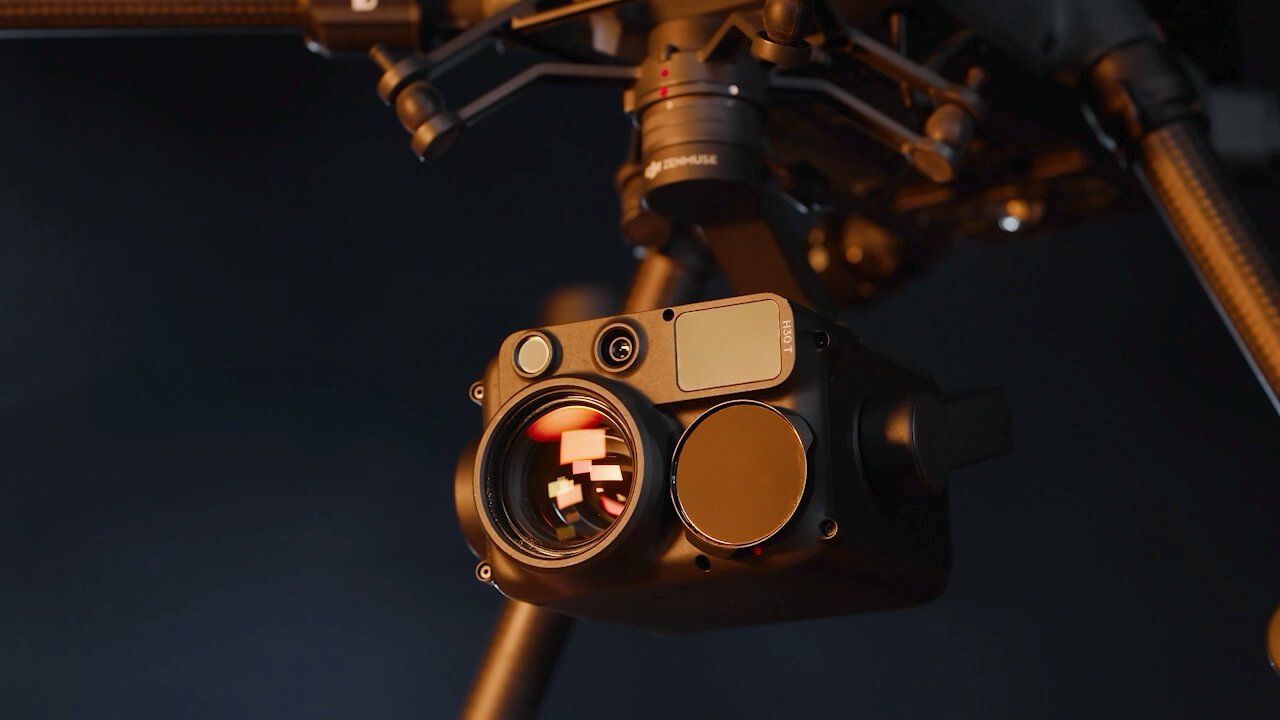
Wide + zoom + LRF + NIR.
The thermal is the fifth sensor.
H30T includes all four H30 modules plus the thermal: 48 MP 1/1.3″ wide at f/1.7, 40 MP 1/1.8″ zoom with 34× optical and 400× max hybrid, 3 km laser range finder, and 850nm NIR auxiliary light. Single payload, single SD card, single power feed, integrated UI for switching between modules. Operationally lighter than carrying a 4-sensor payload plus a separate thermal payload.
Spot, area, centre point.
10 thermal palettes.
Three measurement methods: spot, area, and centre point temperature. Temperature alert thresholds set per mission for automated notification when readings exceed bounds. FFC (Flat Field Correction) auto and manual. Ten palette options — White Hot, Black Hot, Tint, Iron Red, Rainbow 1, Rainbow 2, Medical, Arctic, Fulgurite, Hot Iron. Each palette suits different inspection scenarios: Medical for fever screening, Iron Red for substation hotspots, Arctic for cold-loss surveys.

±0.002° hover.
±0.004° in flight.
Three-axis stabilisation with angular vibration range ±0.002° in hover and ±0.004° during forward flight — the tightest spec in DJI's enterprise payload line. For thermal radiometry this matters: a 0.01° gimbal jitter at 200m operational altitude smears across roughly 3.5cm of ground, blurring the pixel temperature reading. The tighter spec means more reliable spot measurements during inspection sweeps.
DJI Thermal Analysis Tool 3.
R-JPEG with embedded temps.
All thermal imagery captures as R-JPEG with embedded per-pixel temperature data. DJI Thermal Analysis Tool 3 reads R-JPEGs and lets you adjust emissivity, reflected temperature, and atmospheric corrections after flight — critical for accurate readings on glass, polished metal, or water-cooled surfaces where field-set emissivity values are guesses. Export findings to inspection reports or push data into FlightHub 2 for fleet-wide trend analysis.
Module by module.
→ Swipe to scroll


H30T vs H20T.
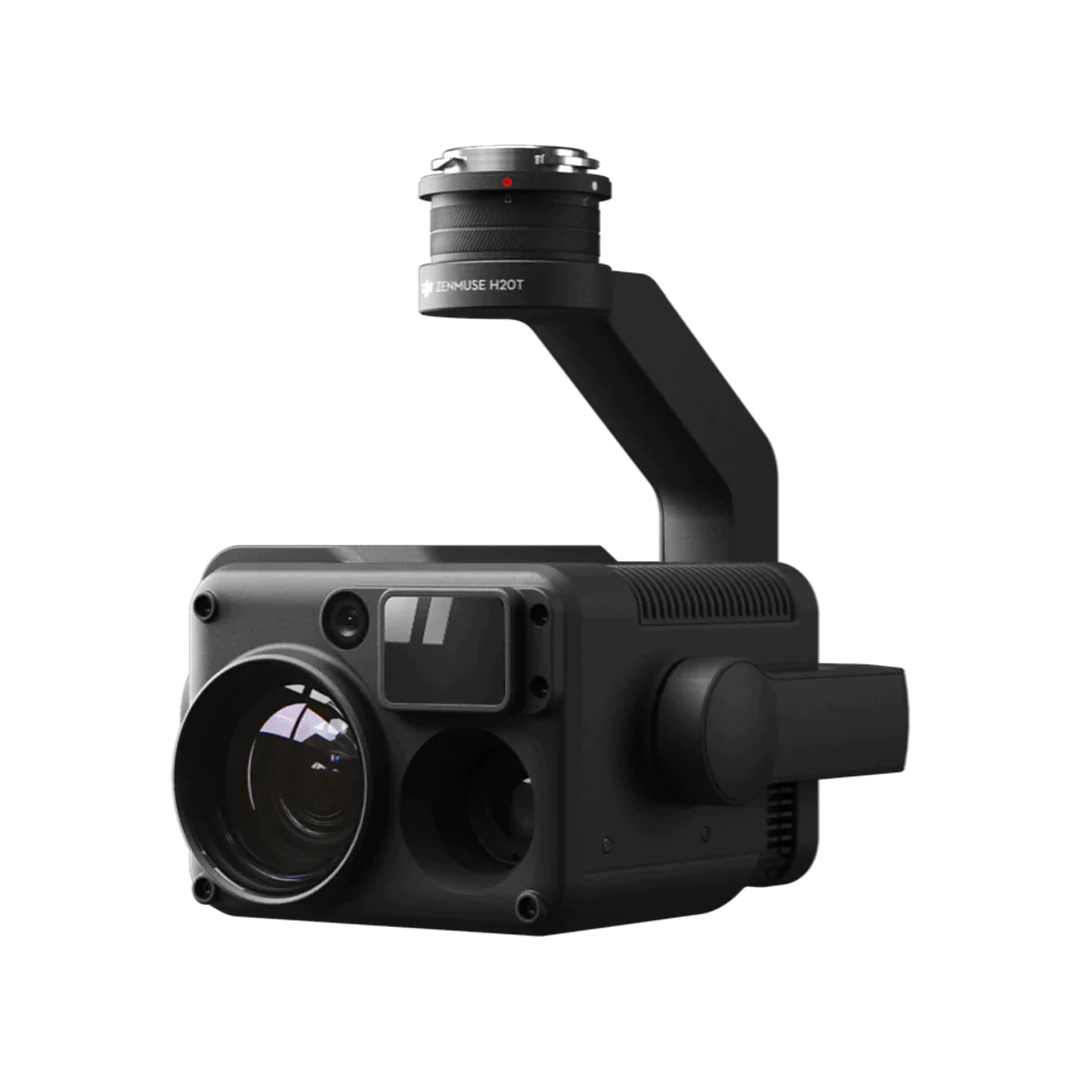
Zenmuse H20T
Older hybrid with thermal
Zenmuse H30T
Current 5-sensor flagship
Supported aircraft.
Confirm current firmware compatibility on DJI's official compatibility page before purchase. Firmware updates can extend compatibility.
Full specifications.
Need to know.
What's actually different from H20T thermally?+
Three things in order of mission impact: (1) Resolution doubled — 1280×1024 vs 640×512. That's 4× the pixel count for the same scene, meaning you can identify thermal anomalies at twice the standoff distance. (2) Faster optics — f/0.95 vs f/1.0 means the H30T resolves slightly cooler thermal differences at the same NETD. (3) Wider temperature ceiling — up to 1600°C with the IR Density Filter vs H20T's 550°C ceiling. The 1600°C range matters for foundry/steel inspection and active fire scenes where H20T saturated.
Which drones is the H30T compatible with?+
Matrice 400, Matrice 350 RTK, and Matrice 300 RTK (with DJI RC Plus controller). H30T does NOT mount on Matrice 30/M30T series. If your fleet is M30T-based and you need higher-resolution thermal, the upgrade path is to add an M350 RTK or M400 airframe specifically for H30T missions, rather than trying to retrofit M30 series.
Calibration and field operation requirements?+
Pre-flight: warm the payload for 5-10 minutes before flight (ambient-temperature drift settles); run Manual FFC if you've just powered on. In-flight: thermal palette and gain mode selectable from the controller. For temperature-critical readings: post-flight in DJI Thermal Analysis Tool 3, set emissivity for the inspected surface (concrete 0.95, polished metal 0.05-0.30, painted surfaces 0.90-0.95) and reflected temperature for ambient. Field-set emissivity values are usually wrong for metal — set them post-flight when you can see the data.
DGCA approval considerations for thermal surveying?+
Same RPC + Digital Sky registration as standard inspection flights. Thermal sensors don't trigger additional permissions in green zones. For night operations (common with thermal): NPNT-compliant flight authorisation specifically for night ops, plus the operator should be type-rated for the airframe being flown. Sensitive infrastructure (defence, refineries, government plants) requires specific clearance from the site authority and may need DGCA Yellow Zone approval. Jetayu can advise on documentation specific to your operation type.
Warranty and service+
1-year DJI manufacturer warranty, 7-day replacement on manufacturing defects, and optional AMC for accidental damage. All repairs at our in-house facility in Sector 66 Gurgaon. Enterprise buyers can also enquire about on-site commissioning and operator training as part of the procurement package.
