India is changing fast. Roads are getting busier, cities are expanding, and customer expectations are rising every year. Today, people do not want to wait three or four days for a delivery. They want it today. Sometimes, they want it within hours.
Now imagine this.
You order medicines for your parents in a small town. Instead of waiting for a courier van stuck in traffic, a drone lifts off from a nearby hub and reaches your location in 15 minutes.
Sounds futuristic?
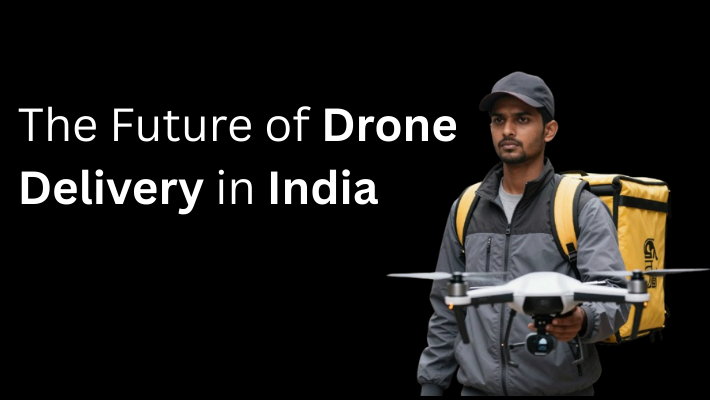
It is not. Drone delivery in India is transitioning from the testing phase to real-world execution. Over the next five years, these sectors could undergo significant transformations, including logistics, healthcare, e-commerce, and even rural connectivity.
Let us explore where India stands today and what the future really looks like.
Why Drone Delivery Makes Sense in India
India has unique challenges:
- Heavy traffic in metro cities
- Poor road connectivity in rural areas
- High logistics costs
- Remote villages in hilly and tribal regions
- Urgent medical needs in hard-to-reach locations
Traditional delivery systems struggle in such situations.
Drones offer something different:
- Faster point-to-point delivery
- No dependency on road infrastructure
- Lower carbon emissions
- Reduced human dependency for last-mile delivery
Current Status of Drone Delivery in India
Drone technology in India has evolved rapidly in the last few years.
The government introduced the Drone Rules 2021, simplifying approvals and airspace management. Then came initiatives like:
- Digital Sky Platform
- Production Linked Incentive scheme for drone manufacturing
- Support for drone startups
- Increasing use in agriculture and healthcare
Several pilot projects have already taken place.
Current Status of Drone Delivery in India
Drone technology in India has evolved rapidly in the last few years.
The government introduced the Drone Rules 2021, simplifying approvals and airspace management. Then came initiatives like:
- Digital Sky Platform
- Production Linked Incentive scheme for drone manufacturing
- Support for drone startups
- Increasing use in agriculture and healthcare
Several pilot projects have already taken place.
Here is a quick snapshot.
| Sector | Current Use Case | Real Impact |
|---|---|---|
| Healthcare | Vaccine and medicine delivery | Faster rural access |
| E-commerce | Pilot last-mile delivery | Reduced delivery time |
| Agriculture | Crop monitoring and spraying | Improved productivity |
| Government | Disaster relief supply | Emergency response |
The shift has already begun.
The Biggest Opportunity: Last-Mile Delivery
In India, last-mile delivery is the most expensive and time-consuming part of logistics.
For example:
- Urban deliveries face traffic delays
- Rural deliveries require a long travel for small packages
- Hilly states like Uttarakhand or Northeast India face access challenges
Drone delivery can solve this by creating micro fulfillment hubs. From there, drones can travel directly to the customer.
This model can:
- Cut delivery time by 50 to 70 percent
- Reduce operational cost in remote areas
- Increase delivery reach in villages
Imagine ordering a mobile accessory in a small town and receiving it within 30 minutes.
That is not impossible.
Healthcare Will Be the First Big Winner
If we look realistically, healthcare will lead the drone delivery revolution in India.
Why?
Because in emergencies, speed saves lives.
Drones are already being tested for:
- Blood delivery between hospitals
- Transport of vaccines
- Delivery of life-saving medicines
- Lab sample transport
In rural India, patients sometimes travel hours for diagnostic tests. With drone-enabled logistics, samples can be transported quickly to labs, and reports returned faster.
This can:
- Reduce mortality rates
- Improve rural healthcare infrastructure
- Support telemedicine growth
The impact here is not just commercial. It is social.
E-Commerce and Quick Commerce Integration
India’s e-commerce market is booming. Quick commerce companies promise 10-minute deliveries. But maintaining such speed using bikes and vans is costly and chaotic.
Drone integration can:
- Reduce dependency on delivery riders
- Lower fuel costs
- Improve efficiency in high-demand zones
However, drones will not replace human delivery completely. Instead, a hybrid model will emerge.
Here is how it may work:
What About Regulations and Safety?
This is where things get serious.
Drone delivery is not just about flying machines. It involves:
- Airspace safety
- Privacy concerns
- Security risks
- Noise control
- Weather challenges
India has already introduced structured airspace maps dividing zones into:
- Green zone
- Yellow zone
- Red zone
Future growth depends on:
- Strong UTM systems, Unmanned Traffic Management
- AI-based collision avoidance
- Strict compliance by operators
- Real-time monitoring systems
Without regulatory clarity, mass adoption cannot happen.
But the government appears supportive, which is a positive sign.
Technology Advancements That Will Drive Growth
The future of drone delivery depends heavily on innovation.
Key technologies shaping the next phase include:
1. Longer Battery Life
Current drones have limited flight time. Future batteries and hybrid power systems will increase range.
2. AI Route Optimization
Smart algorithms will calculate the fastest and safest routes in real time.
3. Autonomous Navigation
Minimal human intervention will reduce operational costs.
4. Lightweight Materials
Stronger and lighter drone frames will improve payload capacity.
5. 5G Integration
High-speed communication will allow real-time control and monitoring.
As these technologies mature, drone delivery will become commercially viable at scale.
Urban vs Rural Future: What Will Happen First?
Drone delivery adoption may differ in cities and villages.
| Factor | Urban Areas | Rural Areas |
|---|---|---|
| Traffic congestion | High | Low |
| Road connectivity | Good | Often weak |
| Delivery demand | Very high | Moderate |
| Use case priority | E-commerce | Healthcare |
| Feasibility | Medium | High in remote zones |
Final Thoughts
The future of drone delivery in India is no longer just an idea on paper. It is unfolding step by step, powered by innovation, smart regulation, and growing demand. When we talk about drones in India, we are not talking about experiments anymore. We are talking about a real shift in how goods, medicines, and essential supplies will move across the country.
Yes, there are challenges.
Yes, regulations and infrastructure still need improvement.
But the direction for drones in India is clear and forward moving. From healthcare corridors to e-commerce hubs, drones in India are slowly becoming part of the logistics conversation at a national level.
In the next decade, looking up at the sky and seeing a package delivered through drones in India might feel completely normal. What seems futuristic today will soon become routine, especially in cities battling traffic and rural areas struggling with connectivity.
And when that moment arrives, we will realize that the rise of drones in India did not happen overnight. It was built through policy reforms, startup innovation, technology upgrades, and increasing consumer acceptance.
The sky is no longer the limit for drones in India.
It is becoming the new delivery route.